What is the working principle of a horizontal carbon steel storage tank
Information summary:1、 Basic Definition
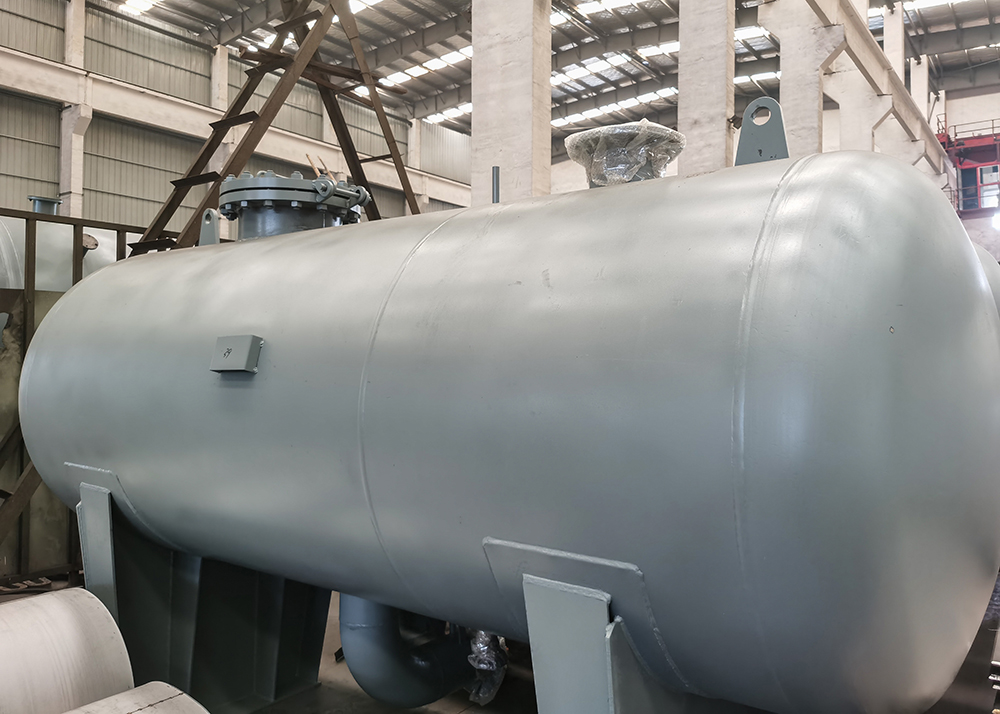
Horizontal carbon steel storage tanks belong to atmospheric and low-pressure static equipment. The cylinder is horizontally arranged and made of carbon steel (mainly Q245R and Q345R). They are mainly used for storing liquid media (oil products, chemical raw materials, sewage, solvents, etc.), and the design pressure is mostly atmospheric or slightly internal pressure (ge
1、 Basic Definition
Horizontal carbon steel storage tanks belong to atmospheric and low-pressure static equipment. The cylinder is horizontally arranged and made of carbon steel (mainly Q245R and Q345R). They are mainly used for storing liquid media (oil products, chemical raw materials, sewage, solvents, etc.), and the design pressure is mostly atmospheric or slightly internal pressure (generally ≤ 0.1MPa).
2、 Core working principle
Relying on a steel sealed cylinder to form a sealed pressure chamber, utilizing gravity to achieve liquid storage, settling, and feeding/discharging; By controlling the liquid level, pressure, ventilation, and safe release through supporting accessories, stable storage of the medium can be achieved.
The overall operational logic is divided into four parts:
1. Sealed containment
A sealed container is composed of a cylindrical body and elliptical/disc-shaped heads welded at both ends, which contains liquid materials. The carbon steel shell resists the static pressure of the medium and a small amount of gas-phase pressure, and bears the weight of the liquid.
Horizontal structure features: Under the same volume, the liquid level height is lower, and the hydrostatic pressure borne by the tank wall is much lower than that of a vertical storage tank. It is suitable for low pressure, underground/semi underground, and space limited scenarios.
2. Material entry and exit (mainly gravity conveying)
Feed: The material is fed into the tank through the feed pipe;
Discharge: relying on the liquid level difference for self flow output, or using an external pump connected to the bottom of the tank to extract the discharge;
Conventional design: The discharge pipe mouth is higher than the bottom of the tank, with reserved settling space to avoid extracting bottom sludge and impurities.
3. Gas phase spatial equilibrium (principle of ventilation, of utmost importance)
Reserve gas phase space above the liquid in the tank:
Liquid inflow → liquid level rise → gas phase is compressed, pressure increases;
Liquid outflow → liquid level decrease → gas phase expansion, forming negative pressure;
Relying on ventilation pipes and breathing valves to automatically balance internal and external air pressure:
Pressure exceeds the upper limit → exhaled gas; Pressure below negative pressure limit → Inhale air (or nitrogen sealing system inhales inert gas) to prevent tank collapse (negative pressure instability) or overpressure bulging deformation.
4. Safety monitoring and protection
Liquid level gauge: Real time monitoring of liquid level height to prevent overflow of the full tank;
Manholes and sewage outlets: regularly clean tanks and discharge sediment impurities;
Safety valve/breathing valve: extreme working condition overpressure relief;
Grounding device: When storing flammable liquids, static electricity is discharged to prevent static electricity from accumulating and igniting the medium.
3、 The mechanical principles that distinguish horizontal storage tanks from vertical storage tanks
The hydrostatic pressure of the liquid increases with depth, and the height of the liquid column in the horizontal tank is small
The circumferential and axial membrane stresses on the tank wall are lower, and the pressure bearing capacity is more suitable for low-pressure storage;
Disadvantages: Larger footprint, longer tank length for the same volume, and higher requirements for foundation settlement control.
4、 Working principle of optional supporting system (common operating conditions)
1. Nitrogen sealing system (volatile and oxidizable medium)
Use nitrogen to maintain a slight positive pressure in the gas phase inside the tank, isolate the air, reduce medium evaporation, and prevent oxidation; The breathing valve is coordinated with the nitrogen sealing valve to regulate pressure.
2. Heating/insulation system (high viscosity medium: asphalt, crude oil, resin)
External heat tracing steam/heat transfer oil coil tube+insulation layer to maintain medium temperature, reduce viscosity, and ensure smooth discharge.
3. Oil water sedimentation separation
By utilizing the longer retention distance of horizontal tanks, light and heavy media can naturally separate by density difference, achieving simple settling and oil-water separation.








 Service Hotline

 Hotline:0512-52093708
 E-mail:yutezjl@163.com
 Address:No. 101, Taojia Bridge, Dahe Village, Shanghu Town, Changshu City, Suzhou City, Jiangsu Province


 Add wechat
 Contact us
 Telephone